

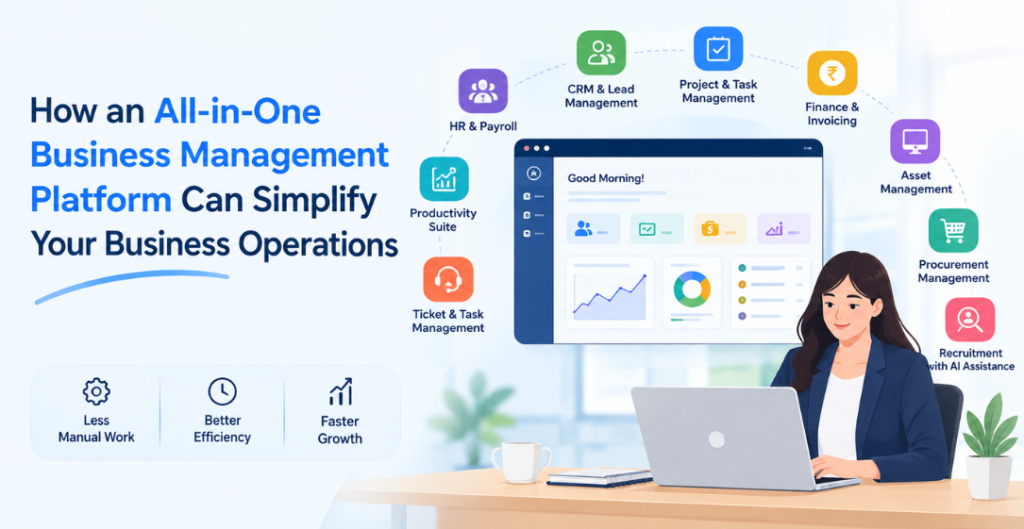
How an All-in-One Business Management Platform Can Simplify Your Business Operations
Running a growing business involves managing employees, customers, projects, finances, sales, and daily operations. However, handling all these functions through separate software can quickly make everyday work complicated.
An All-in-One Business Management Platform brings these essential operations together in one centralized system. As a result, businesses can simplify workflows, reduce repetitive work, and gain better visibility across their organization.
What Is an All-in-One Business Management Platform?
An all-in-one business management platform combines multiple business functions within a single system. Instead of switching between several applications, teams can manage important operations from one connected environment.
For example, a company can use the same platform to manage HR, payroll, recruitment, CRM, projects, productivity, tickets, assets, procurement, and invoicing.
Moreover, connecting these functions allows departments to share information more efficiently. This can reduce duplicate data entry and make everyday business processes easier to manage.
VOffice Desk brings these essential business operations together through one unified business management platform.
Why Do Businesses Need a Centralized Platform?
As organizations grow, their business processes become more complex. At the same time, different departments often start using separate tools to manage their work.
HR may use one system, sales another, while finance and project teams rely on completely different applications. Consequently, important information can become scattered across the organization.
This fragmented approach can lead to:
- Duplicate data
- Manual errors
- Delayed approvals
- Missed sales follow-ups
- Poor communication
- Scattered business information
- Limited operational visibility
- Time-consuming reporting
Therefore, bringing these processes together can help businesses create a more organized and connected working environment.
One Platform. Multiple Business Operations.
A connected business platform allows different departments to manage their responsibilities while keeping important information within the same ecosystem.
1. HRMS & Employee Management
Employee management involves much more than maintaining a basic employee database.
HR teams handle employee records, documents, attendance, leave, payroll, requests, and several other administrative activities. With a centralized HRMS, these processes can be managed from one place.
As a result, HR teams can reduce repetitive administrative work and gain better visibility into employee operations.
2. Attendance & Leave Management
Manual attendance and leave tracking can become challenging as the workforce grows.
A digital system can bring attendance records, work hours, shifts, leave requests, approvals, and balances together. For instance, an employee can submit a leave request digitally while the manager receives a notification for approval.
Once approved, the relevant records can be updated within the system. This reduces unnecessary follow-ups and creates a smoother workflow for employees and HR teams.
3. Payroll Management
Payroll requires accuracy because even a small mistake can affect employee satisfaction.
When payroll is connected with employee and attendance information, HR teams can reduce repetitive calculations and simplify salary processing.
Furthermore, centralized payroll management can make payslip generation and reporting more organized. Therefore, HR professionals can spend less time on routine calculations and more time supporting employees.
4. Recruitment Management
Recruitment involves several stages, including job creation, candidate screening, interviews, selection, and onboarding.
Managing these activities through spreadsheets and emails can make the hiring process difficult to track. Instead, a centralized recruitment system can organize job openings, candidate information, interview details, and recruitment stages.
In addition, recruiters can get a clearer view of their hiring pipeline. This makes it easier to identify active candidates and positions that still require attention.
5. Employee Productivity Tracking
Employee productivity is an important consideration for growing organizations. However, understanding productivity can be difficult when managers depend entirely on manual reports.
A productivity tracking system can provide insights into activity, idle time, task engagement, work patterns, and team performance.
For example, managers can use productivity insights to identify workload issues or areas where employees may need additional support.
The objective is not simply to monitor employees. Instead, these insights can help organizations understand work patterns and improve how teams operate.
6. CRM & Lead Management
Every lead can represent a potential business opportunity. Unfortunately, leads can be missed when sales follow-ups are managed through spreadsheets, emails, or personal notes.
A centralized CRM can organize leads, follow-ups, conversations, pipeline stages, and sales activities in one place.
For example, a sales team can manage its pipeline through a structured journey:
Lead → Follow-Up → Opportunity → Conversation → Conversion
As a result, sales representatives can stay organized while managers gain greater visibility into sales activities.
7. Project, Task & Ticket Management
Managing projects through emails and messaging applications can make responsibilities difficult to track.
A centralized project and task management system provides a clear view of assignments, deadlines, progress, and pending work.
For instance, managers can assign tasks to employees and monitor progress from one place. Similarly, support teams can manage tickets without depending on scattered conversations.
Consequently, teams can improve accountability and managers can identify pending work more quickly.
8. Asset Management
Businesses manage laptops, equipment, office assets, and other resources every day. Without proper tracking, it can become difficult to know who is using an asset or where it is located.
A centralized asset management system keeps important information such as ownership, assignment history, location, and status in one place.
As a result, organizations can maintain better control over their assets and reduce dependency on manual records.
9. Invoicing & Finance Operations
Finance teams need accurate information to manage invoices and business transactions efficiently.
With centralized invoicing, businesses can create and manage invoices while keeping important financial information organized.
Moreover, connecting invoicing with other business processes can reduce duplicate records and unnecessary data entry. This, in turn, helps finance teams manage everyday operations more efficiently.
10. Procurement & Vendor Management
Procurement becomes more complicated as organizations work with multiple vendors and suppliers.
Emails and spreadsheets may work for smaller operations. However, managing larger purchasing activities through disconnected tools can create unnecessary delays.
A centralized procurement system can organize vendor information, purchasing activities, approvals, and procurement workflows.
Therefore, businesses can gain greater visibility into purchasing while keeping vendor information organized.
How Automation Improves Business Efficiency
Automation can remove repetitive administrative work from everyday business processes.
Consider a simple leave request.
Traditional Process
Employee submits request → HR checks details → Manager is contacted → Approval is recorded → Records are updated manually.
Automated Process
Employee submits request → Manager receives notification → Request is approved → Records are updated.
The difference becomes significant when the same workflow happens hundreds of times. Automation can therefore save time while reducing unnecessary manual coordination.
Similarly, automation can support:
- Employee onboarding
- Leave approvals
- Attendance management
- Recruitment workflows
- Lead follow-ups
- Task assignments
- Ticket management
- Procurement
- Invoicing
- Business reporting
Ultimately, employees can spend more time on meaningful work instead of repetitive administrative activities.
Why Choose VOffice Desk?
VOffice Desk brings essential business operations together through one unified platform.
Instead of managing multiple disconnected systems, organizations can access several business functions from one place, including:
- HRMS & Employee Management
- Attendance & Leave Management
- Payroll
- Recruitment
- Employee Productivity
- CRM & Lead Management
- Project Management
- Task & Ticket Management
- Asset Management
- Procurement
- Invoicing
- Employee & Client Communication
- AI Assistance & Automation
Additionally, connecting these functions can improve collaboration between departments and reduce the need to transfer information between different applications.
This makes VOffice Desk a suitable solution for startups, SMEs, growing companies, and organizations looking to centralize their business operations.
Stop Managing Multiple Tools. Start Managing Your Business.
Your business is already complex enough. Therefore, managing several disconnected applications should not make everyday operations harder.
An all-in-one platform can bring essential business processes together and give teams a connected workspace.
For example, HR can manage employees, sales can track leads, managers can monitor projects, finance can manage invoices, and operations can track assets through one platform.
As a result, businesses can spend less time managing software and more time focusing on customers, employees, growth, and results.
The Future of Business Management Is Connected
Modern organizations don’t necessarily need more software. Instead, they need better-connected systems.
When HR, sales, projects, productivity, finance, assets, procurement, and other operations work together, businesses gain better visibility and control.
Furthermore, connected systems can reduce repetitive work, improve collaboration, and support faster decision-making.
That’s the idea behind VOffice Desk:
One Platform. Complete Control. Smarter Business Operations.
From managing your people to tracking everyday business activities, VOffice Desk helps bring essential operations together in one place.
Ready to Simplify Your Business Operations?
Stop switching between multiple tools and start managing your business from one connected platform.
Explore VOffice Desk and discover a simpler way to manage your business.