

Business management is changing rapidly. As companies grow, managing employees, customers, projects, finances, and daily operations through multiple software applications becomes increasingly complicated. Switching between different tools wastes time, creates communication gaps, and makes business processes harder to manage.
In 2027, businesses will increasingly focus on smarter, more connected ways of working. Instead of investing in separate software for every department, companies are moving towards all-in-one business management platforms that bring essential operations together in one place.
1. Why Traditional Business Management Is Changing
Many businesses still depend on spreadsheets, emails, manual reports, and disconnected software to manage their daily activities. While these methods may work initially, they become difficult to maintain as the business expands.
Common challenges include:
- Managing employee attendance and payroll separately.
- Tracking leads and customer follow-ups manually.
- Handling projects without proper progress visibility.
- Managing invoices, expenses, and procurement through different tools.
- Maintaining communication between departments.
Modern businesses need a connected system that simplifies these activities and improves overall operational efficiency.
2. All-in-One Business Management Software Is the Future
An all-in-one business management platform connects different departments and business functions through a single system.
Instead of maintaining multiple subscriptions and databases, companies can manage their operations through one centralized platform.
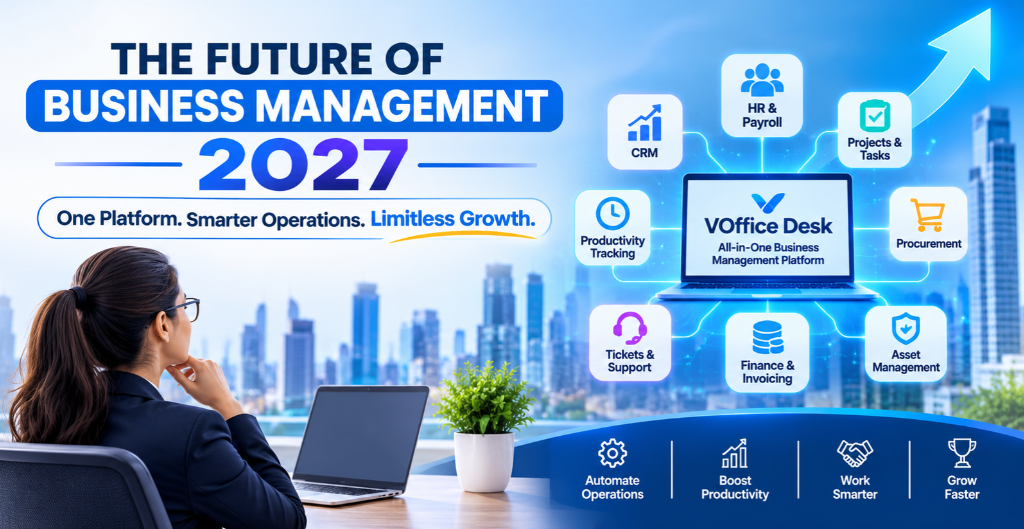
With solutions like VOffice Desk, businesses can bring together HRMS, CRM, productivity tracking, project management, ticket management, finance, invoicing, asset management, and procurement.
This approach helps teams collaborate better, access information faster, and maintain greater control over business operations.
3. AI Automation Will Reduce Manual Business Work
Automation will play an important role in future business management. Companies want to spend less time on repetitive administrative activities and more time on business growth.
AI-powered business platforms can help with:
- Automating routine workflows and follow-up reminders.
- Identifying important sales opportunities.
- Improving recruitment and candidate screening.
- Analyzing employee productivity.
- Identifying operational delays and bottlenecks.
These capabilities help businesses make informed decisions while reducing unnecessary manual work.
4. Smarter HR and Employee Management
Employee management is becoming more technology-driven. Modern HR departments need more than basic attendance and payroll software.
Future-ready HRMS solutions will focus on simplifying the complete employee lifecycle, from onboarding to payroll management.
Businesses can benefit from:
- Digital employee records and onboarding.
- Attendance and leave management.
- Automated payroll processing.
- Employee requests and HR workflows.
- Recruitment and candidate management.
- Employee performance and productivity insights.
With integrated HRMS solutions, companies can manage their workforce more efficiently while improving the employee experience.
5. Real-Time Employee Productivity Tracking
With remote, hybrid, and office-based teams, understanding employee productivity has become increasingly important.
Businesses need better visibility into working hours, application usage, activity levels, and overall work performance.
Modern productivity tracking solutions help managers understand how work is progressing without depending entirely on manual reports.
VOffice Desk’s Productivity Suite helps businesses monitor employee activity on laptops and mobile devices, track working hours, and gain insights into team productivity.
6. Connected CRM and Customer Management
Customer relationships are essential for business growth. However, managing leads, calls, quotations, and follow-ups manually can result in missed opportunities.
Modern CRM platforms help businesses organize their complete sales journey.
Important capabilities include lead tracking, sales pipeline management, customer communication records, follow-up reminders, and quotation tracking.
With connected CRM and intelligent automation, sales teams can manage customer interactions more effectively and improve their chances of converting leads into customers.
7. Better Project and Task Management
As businesses grow, coordinating employees, deadlines, and multiple projects becomes more challenging.
A centralized project and task management system helps teams:
- Assign tasks to responsible employees.
- Monitor task progress and completion.
- Track pending activities and deadlines.
- Measure time spent on tasks.
- Identify delays and workflow issues.
This improves accountability and helps managers maintain better control over ongoing projects.
8. Centralized Finance, Assets, and Procurement
Managing financial activities, company assets, and procurement through separate systems can create unnecessary complexity.
Future-ready business platforms will bring these operations together.
Businesses can manage invoices, billing, financial records, vendor information, procurement requests, and company asset allocation through centralized systems.
This reduces paperwork, improves record management, and makes important business information easier to access.
9. Why Businesses Need One Connected Platform in 2027
The future of business management is not simply about using more software. It is about using technology that connects people, processes, and information.
An integrated platform offers several advantages:
- Reduced Software Costs: Manage multiple business functions without depending on numerous disconnected applications.
- Improved Productivity: Reduce repetitive administrative work and simplify daily activities.
- Better Collaboration: Connect departments through shared information and workflows.
- Centralized Data: Access important business information from one platform.
- Faster Decision-Making: Use real-time insights to understand business performance.
- Scalable Operations: Support business growth with connected management tools.
10. VOffice Desk: One Platform for Smarter Business Management
As businesses prepare for 2027, choosing the right technology will become an important part of their growth strategy.
VOffice Desk brings essential business management functions together in one platform, helping organizations simplify operations and improve team collaboration.
From employee management and recruitment to CRM, productivity tracking, project management, finance, invoicing, assets, and procurement, VOffice Desk helps businesses manage their daily operations through a connected system.
Instead of switching between multiple applications, businesses can manage more activities from one centralized platform.
The future belongs to businesses that work smarter, automate better, and manage everything more efficiently.
Ready to Simplify Your Business Operations?
Discover how VOffice Desk can help your organization streamline daily activities, improve productivity, and prepare for the future of business management.
Start Your Free Trial Today or Book a Demo with VOffice Desk.